Hanni
The Woman in Cabin 10Hanni is a stewardess working aboard the Aurora Borealis, where she performs the emotional and practical labor required to keep a maiden voyage appearing orderly. She appears through lists, trays, itineraries, and carefully managed interactions rather than through an extended personal history, but those brief appearances establish her as both an essential worker and a witness to the ship’s unstable atmosphere. Her role becomes significant because the luxury vessel’s promise of seamless comfort repeatedly collides with missing information, technical failures, and the threat surrounding Laura Blacklock’s account of a woman disappearing from Cabin 10.
Identity and Work
Hanni’s duties include coordinating passenger services and responding to operational problems. When the spa schedule is arranged, Eva assigns Miss West an aromatherapy session, Miss Jenssen a facial, and Laura Blacklock a mud wrap, while Hanni is involved in the hospitality system that makes such carefully programmed luxury possible. Her work is therefore part of the Aurora Borealis’s larger performance of abundance: passengers are given treatments, champagne, presentations, and an itinerary designed to make the voyage feel effortless, even when the staff must constantly adjust behind the scenes.
Her position also places her close to the ship’s information channels. When the Internet fails, Ben Howard explains that the router is malfunctioning and that Archer has complained to Hanni about it. Archer’s anger is directed at a junior employee who has little power to repair the system herself; she is described as having gone to Camilla Lidman for help and as appearing close to tears. The episode shows Hanni absorbing the emotional cost of a technical failure while the passengers interpret the problem as one more teething difficulty of a maiden voyage.
Hospitality and Crisis Management
Hanni participates in the Aurora Borealis’s formal rituals as well as its emergency adjustments. When Laura Blacklock is offered champagne, Hanni is among the staff sustaining the ship’s welcoming routine, and she later informs Laura that the evening presentation on the northern lights has been canceled. The talk was supposed to be delivered by Lord Bullmer with photographs by Cole Lederer, but Richard Bullmer has been called away to an emergency and Cole has injured his hand; the event is postponed until after the group returns from Trondheim. Hanni’s announcement converts a potentially alarming disruption into a revised itinerary, preserving the appearance that the voyage remains under control.
That same function acquires a darker meaning after Laura reports that a woman may have been thrown overboard. Johann Nilsson insists that there is no proof sufficient to wake the passengers and says that the ship’s staff can be questioned about the woman Laura saw. He argues that the small, close-knit crew would make it difficult for a staff member to disappear unnoticed. Hanni is thus part of the workforce whose apparent completeness is used to contain the report: if no employee is officially missing, the possibility that the woman belonged to the crew can be treated as a problem of perception rather than a confirmed emergency.
The pressure is institutional as well as personal. The Aurora Borealis is on its maiden voyage with journalists, photographers, and influential guests aboard, and an unexplained death could damage the entire enterprise before it has properly launched. The consequences would extend from Nilsson’s job to the livelihoods of employees throughout the vessel, including a cleaner such as Iwona. Hanni’s frightened response to Archer’s complaint belongs to this same structure of responsibility without authority: staff members are expected to absorb dissatisfaction and help protect the ship’s reputation, even when they cannot control the conditions producing the crisis.
Encounters with Archer
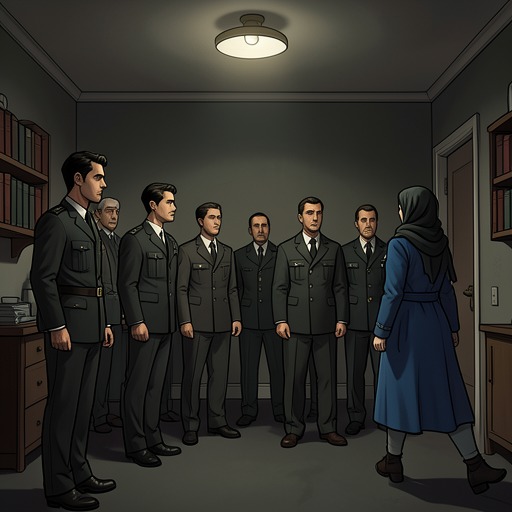
Hanni’s clearest scene of vulnerability comes after dinner, when Archer is extremely drunk and corners her beside the lounge window. He blocks her exit with his broad frame while she holds a coffee jug and maintains a polite smile marked by wariness. Her gestures toward the coffeepot function as a professional excuse to leave, but Archer places an arm around her shoulders in a possessive, ostensibly avuncular gesture. The scene exposes the violence latent within the ship’s social hierarchy: his status as a guest permits him to turn hospitality into access to her body and movement.
Hanni’s response is controlled rather than passive. She slips out from under his grip with what appears to be practiced dexterity, suggesting that this is not an unfamiliar kind of situation for her. Archer’s face briefly shifts from foolishness to fury before he moves away and begins talking to Ben Howard. Her escape is small and tactically executed, not a public confrontation, but it is a meaningful assertion of bodily boundaries within a setting that expects her to remain agreeable. Laura Blacklock’s mixture of relief and discomfort as she watches the incident also marks Hanni as someone whose danger is visible even when the surrounding society prefers not to name it.
Archer’s earlier complaint about the Internet and his later treatment of Hanni form a revealing pattern. In both encounters, he directs frustration downward toward a worker whose role is to assist him. The first episode leaves Hanni nearly in tears; the second turns drunken entitlement into physical intimidation. Together they show how the ship’s service culture can require Hanni to transform hostility into a manageable customer interaction, protecting the guest’s comfort while leaving the employee to evade the immediate threat alone.
Connections to the Disappearance
Hanni’s position makes her relevant to the search for the missing woman without making her a central investigator. Laura asks whether the woman in Cabin 10 might have been a staff member, and Nilsson responds that no staff member is known to be unaccounted for. The logic depends on administrative visibility: a worker’s absence should be noticed because the crew is small, yet the same organizational structure can obscure what individual employees know or fear. Hanni belongs to the group whose labor keeps records, schedules, rooms, and passenger expectations functioning, but the narrative shows that official order does not necessarily guarantee truthful knowledge.
Her practical communications also help maintain the ship’s controlled surface during the investigation. She conveys changes to the northern-lights presentation and handles drink service even as guests are injured, arguments spread, and Laura’s credibility is being undermined. The contrast between her professional language and the growing disorder around her embodies the Aurora Borealis’s central contradiction: the vessel can continue offering champagne and scheduled entertainment while a potentially fatal event is being denied.
Narrative and Thematic Significance
Hanni represents the less visible labor beneath the Aurora Borealis’s luxury. Camilla Lidman introduces the vessel through hospitality, facilities, and carefully timed activities, while Hanni’s appearances show the cost of maintaining that welcome. She is expected to solve or relay problems, absorb the anger of powerful passengers, and remain composed in public. The ship’s polished front stage therefore depends on workers who must manage distress in the background without receiving equivalent protection.
Her interactions also sharpen the novel’s treatment of willful blindness and testimonial credibility. Archer’s conduct is plainly threatening, yet it is framed through drunkenness and social embarrassment rather than openly confronted as abuse. Similarly, Laura’s report is treated as insufficiently evidenced even though the ship’s institutional interests make disbelief convenient. Hanni’s wary smile, near-tears, and practiced escape register facts that the ship’s formal procedures do not fully acknowledge.
Hanni does not receive a dramatic independent resolution in the supplied episodes, but her limited presence is purposeful. She remains part of the living crew whose work allows the Aurora Borealis to proceed through disruption, and her survival of Archer’s advance offers a brief counterpoint to the larger failures of protection aboard the ship. Through her, the narrative makes the vessel’s hierarchy tangible: luxury is presented to passengers as comfort, while for employees such as Hanni it is also a disciplined performance carried out under pressure, exposure, and unequal power.